NEW TECHNIQUES XVI: Hana Umeda, Cheng-jung Tsai, Frieda Luk – Sophiensæle | Independent Theater in Berlin
NEW TECHNIQUES XVI: Hana Umeda, Cheng-jung Tsai, Frieda Luk
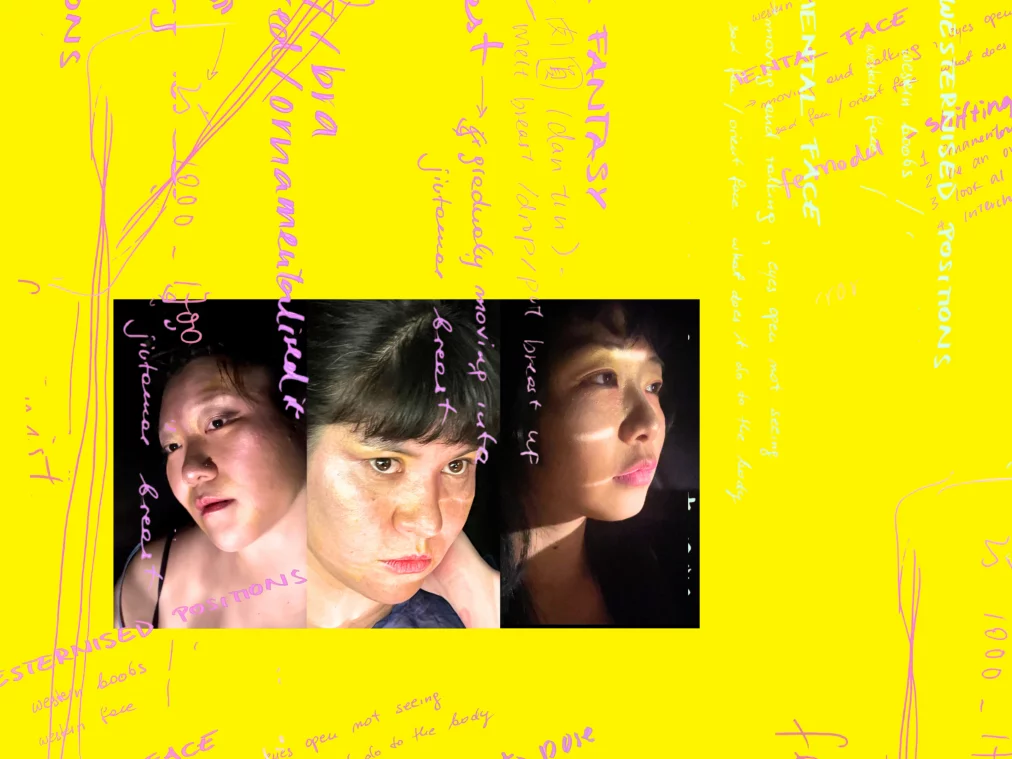
In March/April 2026, Sophiensæle welcomes choreographers Hana Umeda, Cheng-jung Tsai and Frieda Luk and their team as part of the dance residency program NEW TECHNIQUES.
Starting from American scholar Anne Anlin Cheng’s Ornamentalism, Hana Umeda, Cheng-jung Tsai and Frieda Luk collectively unfold what it means and what it costs, to be a Yellow woman living in a white-dominant society, and trace the relationship between Ornamentalism their personal life stories, and embodied practices.
During the residency, they dived into Ornamentalism, practicing embodied reading, dismantling orientalist fantasies and reconstructing with speculative ancestral bodily knowledge. With their different cultural context (Japan/Poland, Hong Kong and Taiwan), they explore the constant negotiation between “Asiatic femininity” and “Asian Femininity”, while mapping the distance between borders, bodies, and their different proximity to Whiteness. They ask: “how can performance, beyond reproducing stereotypes, share the weights of the injured bodies of Yellow women? How to shift the ornamentalized gaze and create space for agency. What do we have to offer as Yellow women to intersectional feminist practice? When did I become yellow?” Rather than reclaiming “yellow” as a racial category produced through colonialism, they approach it as an anchor for collective reflection, imagination, and solidarity.
With our dance residency program NEW TECHNIQUES, we support early-career artists based in Berlin and simultaneously reflect on the concept of technique in the contemporary dance scene. We have named our residency NEW TECHNIQUES because we want to explore the notion of technique together with emerging dance artists—a term that, in recent decades, has been replaced by “practice” in dance discourse, education, and criticism. We ask what technique might mean in today’s pluralized dance world. This exploration is not only about how existing dance techniques taught in schools and studios (from ballet, modern, contemporary dance, or urban styles) relate to cultural identity, power dynamics, historical contexts, or social practices, but also about how other forms of embodied knowledge and self-technologies passed down in our communities and societies influence the field of dance and the artistic practices of the invited choreographers.
The NEW TECHNIQUES residency program is part of the Residency Support for Berlin dance artists, through which the Berlin Senate Department for Culture and Social Cohesion first introduced and awarded residency programs in 2020.
Residency: Hana Umeda, Cheng-jung Tsai, Frieda Luk
Artistic advisors: Scarlet Yu, Thu Hoai Tran
Hana Umeda, Frieda Luk and Cheng-jung Tsai began a research about embodied practices of yellow feminism and formed a friendship with shared interest in both body-based research and community building. Hana and Frieda graduate from the MA programme Solo/Dance/Authorship (HZT Berlin) and Cheng-jung holds a BA in Dance from the Jerusalem Academy of Music and Dance.
Hana Umeda, from Poland/Japan, has an artistic practice that brings the corporeality of Jiutamai into a contemporary art context. In her works, she explores the embodied experience and possibilities of transformation, often addressing diverse types of violence.
Frieda Luk, from Hong Kong, investigates the intersections of language, memory, and fractured history.
Cheng-jung Tsai, from Taiwan, whose work moves across bodily practice, curation, and community organizing, engaging with collective memory, body politics, and creating spaces for decolonial imagination and practice.
They continue to develop their research together as a collective.